/w=1920,quality=90,fit=scale-down)


Melissa Warner


12 Min
Read on Substack:
Signals in the Noise
You wake up, but before your feet touch earth, your fingers find the feed.
Outside, the photons of the actual sky are waiting. But you’ve already absorbed your first light of day, not from the sun, but from a touchscreen.
You scroll past a birthday, a bikini ad, budget cuts, a baby’s first smile, a bombing, a Buddhist quote, and a banana-wielding capybara.
Our attention performs its first act of forward ambulation not in the world, but through the digisphere. You have walked nowhere. And yet your attention has travelled miles.
Before your coffee is brewed, your feed has curated rage, beauty, tragedy, and rapid fire dopamine, all in the span of 30 seconds.
If this sounded somewhat like your morning, you are not alone. If you are also one of the few who have managed to fight this tech-overtake of the limbic system, and own your AM attention, and your first act of forward ambulation is in fact walking, kudos, I salute you. Fewer and fewer of us start the day with the celestial photons of the sun, and more and more the synthetic pixels of a screen.
Let’s turn to some stats to evoke the lived experience of the data streams daily encroachment…
- The average person touches their phone over 2,600 times a day.
- Ninety percent of the data in the world today was generated in the last few years, and much of it is generated about you, our collective digital imprint of ‘consumer’ behaviour.
- Social media platforms now predict your behaviour more accurately than your intimate partner, your therapist, and even psychological science itself, not just what you’ll click, but what you’ll feel, buy, or believe tomorrow.
Perhaps more salient for those exploring the nexus of immersive tech, A 2022 academic report predicted that the next generation will spend around 10 years of their lives in Virtual Reality (VR), an average of 2 hours and 45 minutes per day.
A separate expert panel convened by KPMG offered a more radical projection: That by 2030, people may spend more of their conscious waking time in the metaverse than in the physical world. Yes, these experts forecast we will be navigating education, work, social life, and even major life events in digital spaces.
And who knows, maybe this will all work out swell.
Social media’s role in the mental health crisis? Apparently, just a growing pain of the digital age... Groupthink effects that are inflated by algorithms turn out to be a bump-in-the-road to awakened collective coherence. And our AI companions, benevolent and efficient, will help us reach the light of awareness, all while ensuring we never have to write a sentence ourselves, ever again.
Underneath the gentle cadence of digital care, the world is suffering, economies wobble, and attention thins. What we call wellness can be rendered in pixels, but is it embodied? What we call integration might be designed, but is it lived?

Now Project Yourself 10 Years Into The Techno-Utopian Future…
You slip into your interface, where you begin your day on a virtual mountain with breathwork guided by a AI llama with a Bhutanese accent (a new avatar, as you found the pastiche of the Yoda avatar had become dulled with repetition). The air is algorithmically crisp. Your feet, of course, are on the cold floor of your apartment (heating prices keep going up).
After your “resonance scan” gives you a green light, you jump into your work portal; a serene spatial office where you greet your co-worker, who appears as a floating jellyfish today, AI-suggested small talk options ready to select. By 9:00am you’ve centered, flirted, and co-regulated… all without leaving your soft, crumb-filled couch.
It’s seamless. Convenient. Beautiful, even.
But whose world will this really be?
As the AI now writes your journal for you, with deep emotional insight, and a playful tone.
You don’t miss your pre AI-unrendered self… that much.
As the seams between physical, digital, and psychological realities dissolve, the feedback loops we inhabit are becoming more immersive, more intimate, and more invisible. And they are not neutral.
That vignette was not a vision of dystopia or utopia. Nor is this a luddite lament. This is a call to attention. Because technology isn’t the problem. Unconscious engagement is.
In this future, we risk replacing embodied transformation with digital catharsis. While rituals of the interface might soothe, will they align us with wisdom? Will they restore relationship; personal, interpersonal, ecological? Or will we be seeking sacred symbols in a superficial system?
And yet, as there have always been technologies of control, there have always been technologies of revelation. Ancient rituals encoded them in fire and fungi. Artists etched them in glyph and song. Monks trained attention like a muscle. Now, we train algorithms. And they, in turn, train us.
In an era where technology permeates every facet of our lives, the intersection of digital innovation and altered states of consciousness is no longer speculative. It is experiential. Whether through virtual experience, multisensory meditation, AI-guided breathwork, or biofeedback rituals, the boundary between code and consciousness is more malleable than ever.
So what do we call this threshold we’re standing at? This liminal space of inner exploration and technological mediation? This emerging fusion of the cybernetic and the psychedelic?
Before we dive into history, design, tools, or applications, we need to understand the language. Because language shapes perception, and perception is what’s at stake.
In this first post, we’ll explore the roots of the term cyberdelic, its etymology, its tensions, and why this odd, rather charming word still holds potential. In future posts, we’ll trace its cultural evolution, map the growing field of tools and practices it encompasses, and explore its intersection with the fields of philosophy, psychology, contemplative practice, technology and art.
Cyberdelic Systems Scan
Before going further, it’s worth doing a quick check-in, a mini systems scan of your own habits and loops:
- Who or what decides what you see online, and how often do you notice?(Each platform’s recommendation AI is essentially a feedback system feeding you what it predicts will keep you engaged… not necessarily what’s meaningful for you.)
- What are your clicks and swipes training your mind to value?
Every time you “like” or share or linger on a piece of content, you’re effectively giving that feedback loop a thumbs-up. Over time, you’ve trained a thousand micro-algorithms to assume “this is what I want.” Is it?
(Notice. Breathe. Re-enter with intention.)
Cyberdelics: From Control to Co-Creation
Today, the word cyber often evokes images of digital systems, algorithmic loops, virtual classrooms, and viral memes. We hear of cyberspace, cybersecurity and even cybercrime as being part of the digital world.
Even in benign contexts, cybernetics is often associated with control systems in machines, a field concerned with signals, sensors, and simulations.
But this is only a sliver of its meaning.
When Norbert Wiener coined cybernetics in the 1940s, he wasn’t speaking only of machines. In his seminal 1948 book Cybernetics: Or Control and Communication in the Animal and the Machine, Wiener defined the new science as “the scientific study of control and communication in the animal and the machine.”
Cybernetics was always a science of feedback, of how systems regulate themselves, respond to change, and maintain dynamic balance. For Wiener, cybernetics was not just about computers. It was about systems that adapt through feedback. Whether it is a thermostat regulating temperature, a flock of birds shifting direction, or a conversation shaping thought, cybernetics describes the principles by which systems stay in relationship with their environment. Whether the system is biological or technological, cybernetic processes ask us to notice how awareness moves through a feedback loop.
Understood this way, cybernetics is not confined to code. It is woven into nature.
Trees follow the sun. Bodies balance fluids and heat. Migratory animals adjust to the changing magnetism of the Earth. Feedback is everywhere. It is the pulse of adaptation, of relationship. In this light, cybernetics is not just a technological concept. It is a way of understanding living systems, and by extension, our place within them.

We Forget That Nature is Cybernetic.
Flocks, forests, weather systems, all shift through feedback. The cybernetic, then, is not a departure from the organic. It is a return to the intelligence of self-adjusting systems. A rewilding of perception. A restoration of our place within a web of interbeing.
The original meaning of cybernetic reminds us that to be in any system, digital, social, or biological, is to be in a relationship. And the key question becomes: with what awareness?
Afterall, beneath even this broader understanding of the word lies a much older lineage, one that speaks not just to technology but to the art of navigation, of choosing a direction, of agency.
The root of cybernetic comes from the Greek word kybernētēs, meaning helmsman or steersman. It was used to describe the art of navigation, how one guides through changing conditions by sensing, adjusting, and responding.
To steer is not merely to control. It is to sense subtle shifts and respond in kind. This is the essence of mindful navigation, a practice rooted not in domination but in attunement.
In quantum physics, observation is not neutral, it changes what is seen. Likewise, in consciousness, awareness is not separate from experience. It participates in shaping it.
The kybernētēs reminds us that perception is not passive. It is participatory.
We are not passengers in these systems. We are co-creators, capable of adjusting our course, shifting feedback, and remembering intention. The cyberdelic, then, is not simply control. It is about calibration. It is the stance of the helmsman: present, perceptive, and poised to respond.
This is where cyberdelic begins to take shape. The word combines cybernetic with psychedelic, from the Greek psyche meaning soul or mind, and delos, to reveal or make manifest. Cyberdelic, then, refers to the art of navigating the revealing of, the manifesting of, mind. Technology to reveal relationship. The art of steering the mind.
In a time when algorithms predict our behaviour and shape our desires, the cybernetic loop has become weaponised. We are not simply observers, we are observed. We are influenced, nudged, and patterned without consent.
Perhaps cyberdelia can invite another stance. It suggests we are not just subjects within loops. We are also agents within them. We can choose which feedback we attune to. We can design our own feedback systems that support reflection rather than reaction. To synchronise our compass with the greater choreography of life.
Cyberdelic then, points to the possibility of technologies of revelation and co-regulation, rather than simply technologies of control. Cyberdelic is an invitation to remember the opportunity of navigation, amidst the current and eddies of a complex system. The invitation to learn to steer, attuned to the living rhythms that bind self to system, signal to spirit.
This is cyberdelia’s quiet rebellion: the steering of perception in service of interbeing.

Mapping the Lexicon
Language matters. It shapes how we think, what we seek, and where we think we’re going. As immersive tools for shaping inner experience evolve, so too does the vocabulary around them.
At Cyberdelic Nexus, we use the term cyberdelic as a metacategory.
It encompasses a wide constellation of practices and technologies designed to reflect, reveal, or refine perception. The Cyberdelic Nexus does not propose one answer, one state, or one pathway. It is a pluralistic vision. A laboratory of inner technologies.
Each of the terms below reveals a slightly different lens through which to engage altered states and immersive tools:
Technodelic | Tech-driven psychedelic-like states.
Developed and defined by game designer Robin Arnott, who coined the term in a 2012 essay (later formalized in The Technodelic Manifesto), technodelics are immersive technologies, often games, that induce meditative or psychedelic-like states via feedback loops of sound, visuals, and biofeedback. These experiences are intentionally abstract, often with a somatic layer, and designed to disrupt habitual focus and invite surrender into presence.
Examples of technodelic experiences include Arnott’s SoundSelf, originally a VR experience where your vocal toning generates kaleidoscopic visuals and sounds in real-time, now a "Obfuscated Interactive Feedback" algorithm that combines vocal-toning biofeedback, optic neurostimulation, and generative soundscapes to induce rapid relaxation, emotional regulation, and mindfulness.
Other projects in this vein: Deep Sym A unique interactive light that visualizes breathing in real-time, encouraging diaphragmatic breathing, naturally reducing stress and anxiety or MuLabs Voxel Cube which control colors of a 3D cube with your mind using EEG and projection mapping.
Numadelic | Technology for contemplative insight.
Introduced by Dr. David Glowacki and his team at the Intangible Realities Laboratory, “numadelic” combines the Greek words pneuma (spirit or breath) and delein (to reveal), referring to experiences that support connection to the spirit or soul through immersive technologies. Numadelics also feature a distinct aesthetic that is weekly representational. Numadelic experiences aim to support connection to the spirit or soul through immersive technology, often by inducing states similar to mystical or near-death experiences (NDEs). A key distinction of the numadelic approach is its aesthetic minimalism and abstraction, Glowacki emphasizes “weakly representational” environments. This open-endedness allows for deep, personal insights to arise from within, much like what people report during NDEs.
For example, in Glowacki’s multi-person VR journey Isness-D, participants are not shown as human avatars but rather as “luminous energetic essences”, essentially glowing particle fields. This numadelic aesthetic blurs the boundaries between self and other: individual identity is diffused into something like a field of energy. Participants in Isness-D have reported experiences of profound unity and ego-dissolution.
Numadelic Labs and The Intangible Realities Laboratory are now exploring how such immersive, open-ended environments might reduce anxiety around death and dying. Their work aims to apply numadelic design principles to support end-of-life care, creating virtual experiences to practise “letting go” of the usual boundaries of self, and to explore a sense of continuity beyond the physical body. In doing so, they hope to soften existential anxiety and foster a deeper peace at the end of life.
The numadelic approach invites not only a reimagining of death, but a reimagining of inner life. The numadelic aesthetic is already finding further experimental application in self-practice, lucid dreaming, and ecological contemplation. Watch this space.
Spirit Tech | Tools for spiritual growth.
Spirit Tech is an umbrella term popularised by Mikey Siegal in their book Spirit Tech: The Brave New World of Consciousness Hacking and Enlightenment Engineering. It refers to technologies designed to induce, enhance, or support spiritual experiences and conscious development through the science of awakening, AI-driven hyper personalization, interoception tools and non-intrusive modulation of states.
A major hub in this growing field is the Spirit Tech Collective, founded by Edward Vaisberg. The Spirit Tech Collective aims to elevate the spiritual technology sector in societal awareness to as vital to human progress as the environmental movement. Through its public database of over 200 organisations, the Collective is helping map the ecosystem of tools, researchers, developers, and visionaries working at the intersection of technology and inner transformation.
Moist-Media | Technology meets biology
Roy Ascott’s moist media sits between the dry logic of code and the wet pulse of biology. It names a class of hybrid tools and environments where body, breath, mind, and machine interact, not as metaphor, but as medium. These are not just immersive visuals or entertainment platforms. They are sensorial feedback systems that can shape states of consciousness, and potentially, traits of self.
Rather than separating the natural from the technological, moist media suggests their recombination. Breath becomes data. Sound becomes structure. The nervous system becomes an interface. These tools do not replace contemplative practice, but extend its palette. They can support coherence, attunement, and awareness across the boundaries of what is usually considered inner and outer.
We are already seeing early forms emerge:
- Virtual environments that track brain rhythms in real time and respond with in game rewards (closed loop systems)
- Psychedelic microdosing coupled with VR based training (this is happening in research - watch this space)
- Meditation sessions paired with ultrasound neuromodulation to stabilize deep states
While there is increasing momentum around combining virtual reality with psychedelic therapy, most published work so far uses VR either before or after psychedelic dosing, or simulates psychedelic effects without drugs. There are strong theoretical reasons and pilot reports that suggest VR could enhance set, setting and skill, help with integration, or scaffold insightful experiences. But as of now there is no robust clinical evidence for using VR with psychedelic states. That remains a frontier that will be explored in future field reports.

Cyberdelics as Frame and View
At Cyberdelic Nexus, we use the term cyberdelic as both a meta-category and a stance.
It is not just a label for a specific tool or technology, but a lens through which we explore how technology shapes, reveals, and invites new ways of perceiving. The Cyberdelic Nexus does not propose one answer, one state, or one pathway. It is a pluralistic vision. A laboratory of inner technologies.
To speak of cyberdelics is to consider the terms above and offer a wider lens. Imbued from the etymology, Cyberdelics invite us to cultivate agency and insight within systems designed to influence us. Cyberdelic tools are diverse, but the thread they share is participatory awareness.
Cyberdelic endures because it refuses to collapse into just one modality.
It holds the tension between:
- System and spirit
- Code and creativity
- Skill and surrender
- Speculation and sense-making
And, crucially, it insists that the practitioner must choose the direction of the feedback loop.
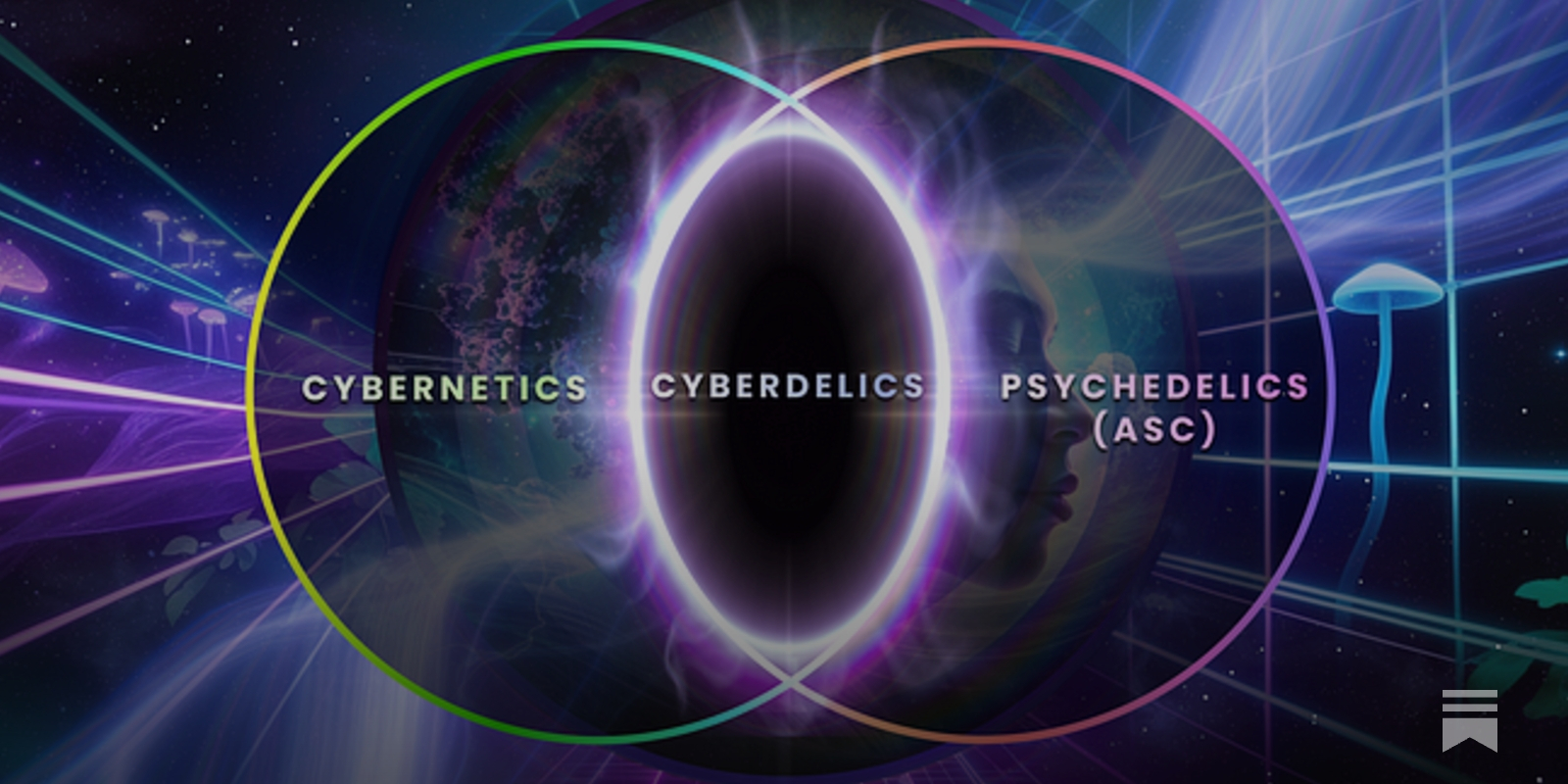
The image below maps five intersecting fields that converge within the cyberdelic space:
At Cyberdelic Nexus, our approach is deeply interdisciplinary.
We work at the convergence of five core domains:
- Immersive Technology
- Experience Design
- Cognitive, Contemplative & Psychedelic Research
- Mindfulness & Metacognitive Practices
- Immersive Art
Our team and collaborators bring expertise across these areas, from building multisensory VR environments, to immersive art installations, to developing contemplative curricula, to studying the psychology of altered states.
Each domain offers a different kind of interface: technology extends perception, design structures experience, research offers insight, art evokes awe, and mindfulness trains awareness.
In future articles, we’ll explore each of these dimensions in greater depth, and trace the generative intersections where they overlap.

Participatory Knowing and the Craft of Awareness
If the old fear of cybernetics was control, the emerging invitation of the cyberdelic is participation.
It is also not about escaping into artificial worlds. It is about restoring coherence in the real one, starting with the most immediate system we navigate: the self (or the illusion that there of – but that’s for a later post!).
So, while at first glance, cyberdelic might sound like a playful fusion of technology and trippiness. (And some of that spirit is welcome.) Beneath the novelty lies a deeper proposition. To adopt a cyberdelic stance is not about escaping into an artificial world or venerating technology. It’s about restoring coherence in the real world by consciously engaging with our tools. That our tools, when engaged with consciously, can become mirrors. Compasses. Catalysts. That perception can be trained. That intentional relational feedback can refine the soul.
This is where participatory knowing enters.
In cognitive scientist John Vervaeke’s framework, participatory knowing is not about knowing facts, or even knowing how. It is about knowing through being. It is a felt, enacted sense of how we are situated in a world and how that world, in turn, reveals itself to us. It is co-emergent, relational, and deeply ecological.
As Vervaeke puts it in Awakening from the Meaning Crisis:
“Participatory knowing is the kind of knowing in which we are bound up with something else, such that there is a reciprocal opening and revelation.” - (Episode 5: Consciousness and Intelligence)
These ideas find further support in enactivism (Varela, Thompson, & Rosch, 1991), which holds that cognition arises through embodied interaction with the world, not abstract computation. Similarly, the extended mind thesis (Clark & Chalmers, 1998) proposes that mind is not confined to skull and skin, but spreads into tools, environments, and relationships. In immersive media, the boundaries of cognition become porous.
To navigate this complexity, we must refine the craft of attention. This is the heart of cyberdelic awareness: learning to sense our own feedback loops, to choose where we place our focus, and to consciously participate in shaping what shapes us. In future field notes, we’ll explore the fragility and power of attention more deeply; how it is trained, tracked, and sometimes taken. We’ll draw from contemplative science, neuroscience, and lived practice to map both the risks and regenerative potentials of attention in the age of immersive tech.
Afterall, Cyberdelic tools are not inherently liberatory. They can dazzle or deceive. They can be used to sedate or awaken. But if we bring the disciplines of contemplative practice, systems thinking, and cognitive science to bear, we have the opportunity to stay in right relationship.
So too, in this emerging landscape, we are invited to listen more deeply, to feel our way toward coherence, and to practice a new kind of craft: participatory, perceptive, and alive to complexity.
In future field notes, we will deepen into these streams of cognitive science and systems theory. We will explore how concepts like enactivism, extended mind theory, predictive processing, and contemplative science might help us train a wiser grip on reality. For now, let us remember:
The interface is not the destination.
The tool is not the teacher.
Attention is the practice.
Open the Doors of Perception, and walk the path of practice.

The Road Ahead
This first post planted a flag. It named a terrain that is emerging, not just of new technologies, but of questions, values, and ways of being.
In future field notes, we’ll map:
- Our guiding ethos: blending inner technologies with outer systems awareness
- Why attention and agency are sacred resources in the digital age (and are at risk)
- The current ecosystem of cyberdelic technologies and practices (XR, AI, biofeedback etc.)
- The therapeutic potentials of cyberdelic tools
- Metacognition as a skillset for sovereignty and transformation
- The pursuit of wisdom in age of influences, peer-review, and techno-utopianism
- Ways we can honour heart-mind, ambiguity, discernment, and awe in equal measure
Please click subscribe to follow the unfolding field guides: nurture your inner compass with ideas, toolkits, and a community to navigate this emerging cyberdelic age.
Cyberdelic Compass Check
At the end of every post, like a closing bell.
Before you click away, pause with these:
- What loops are no longer serving you, and how might you exit them?
- When does awareness feel most spacious for you, and how can you return there more often?
(Chart. Course. Correct.)
Cyberdelic Quests
For the week ahead, try at this experiment:
- Cultivate greater intimacy with the moment before you act…
- Choose a digital habit loop (e.g. looking at your phone in bed) and gently rewire it, not through willpower, but through awareness and aspiration.
(Let perception become practice.)


